From a Sicilian river to a German valley
The ancient Greeks called the river Achates, and the banded stones found there became achates too. The name passed into Latin and then into English as agate. Geology.com notes that agate was among the earliest stones people shaped, and it has been worn and carved for thousands of years.
The most famous chapter happened in Idar-Oberstein, in western Germany. Local agate supported a cutting and polishing industry for centuries. When those deposits ran low, the International Gem Society records that emigrants from the region found rich agate in South America and shipped grey stones back across the Atlantic to be cut at home.
In the 19th century, Idar-Oberstein cutters also perfected ways of dyeing agate. The process was guarded closely, and it is the reason so many brightly coloured agates exist today.
How agate forms its bands
Agate is a banded form of chalcedony, the same microcrystalline quartz family as onyx, carnelian and jasper. Its crystals are far too small to see, even with a loupe.
Most agate grows inside cavities in volcanic rock, often old gas bubbles. Silica-rich water seeps in and lays down layer after layer, either in rings that follow the cavity wall or in flat, level bands. Each band records a small change in the water's chemistry, so no two agates are ever alike. Gem-A points out that structural banding is always present in agate, even when you cannot see colour bands.
Types of agate worth knowing
Banded agate comes mainly from Brazil, Uruguay, Madagascar, Mexico and the United States. Moss agate is not banded at all: it holds green, moss-like inclusions, with classic sources in India and Scotland. Mexico gives the world crazy lace agate, with tight, swirling patterns, and fire agate, which shows a rainbow sheen.
Other names describe the picture inside the stone: dendritic agate has fern-like markings, plume agate has feathery ones, and landscape or scenic agate can look like a tiny painted view. Straight, parallel bands are called onyx, and when those bands sit over a reddish base the stone is sardonyx.
The facts
- Mineral family
- Quartz (chalcedony)
- Chemical formula
- SiO₂
- Mohs hardness
- 6.5–7
- Refractive index
- 1.530–1.543
- Specific gravity
- 2.60–2.64
- Crystal system
- Trigonal (microcrystalline)
- Colours
- White, grey, brown, red, orange, yellow, black and many natural combinations; blue, green, pink and purple are usually dyed
- Main sources
- Brazil, Uruguay, India, Mexico, Madagascar, USA, Scotland
- Birthstone
- —
- Common treatments
- Dyeing (very common and generally stable), heating
What makes a good agate
Agate value is modest as material, so the price you pay mostly reflects pattern, size and the skill of the cutting. Look for crisp, well-defined bands or an interesting picture, an even polish with no scratches, and a shape that shows the pattern off. Large slices, matched pairs and fine carvings command more.
Dyed agate is normal and widely accepted, but it should be disclosed. Vivid blues, pinks, purples and bright greens are almost always dyed, because natural agate tends towards softer browns, greys, whites and reds. Natural colour is not better or worse, it is simply a different product with a different price.
- Assume electric blue, pink or purple agate is dyed unless proven otherwise
- Look in cracks and at drill holes: dye often collects there in darker lines
- Natural banding curves and varies; printed or painted patterns look too regular
- Glass imitations feel lighter in tone and may show bubbles under a loupe
- Check the polish under light for scratches and orange-peel texture
- For strands, check bead-to-bead pattern balance and even hole sizes
Keeping it beautiful
At 6.5 to 7 on the Mohs scale with no cleavage, agate is tough and suits rings, bracelets and everyday wear. It is slightly porous, which is why it takes dye so well, so keep it away from oils, perfumes and harsh chemicals that could stain or bleach it over time.
- Clean with warm soapy water and a soft brush, then dry well
- Avoid bleach, solvents and acidic cleaners
- Keep dyed agate out of long, strong sunlight
- Store separately from diamonds, sapphires and rubies
Agate, from D’sire
D’sire has three decades of experience in Hong Kong cutting and calibrating stones for the trade, and agate is a natural fit for strands and beads, cabochons and slices. We can source and cut it to your sizes, and work it into private label or bespoke pieces.


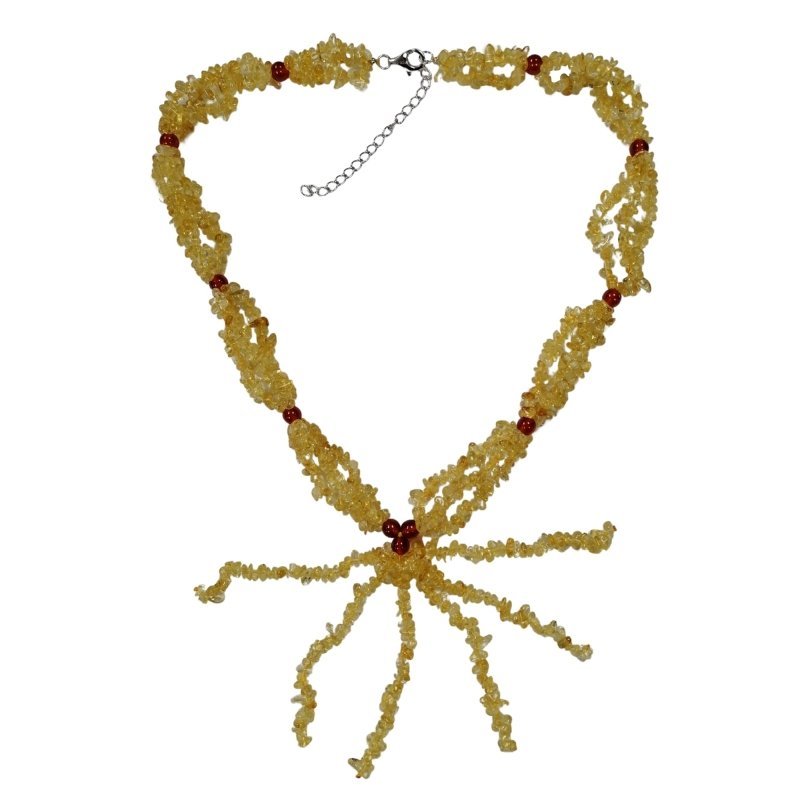
Citrine & Red Agate Gemstone Tassel Necklace

Ladies Black Agate & Rose Quartz Bracelet 7.5-8” Stretch-Fit Beaded Design Natural Stones
Enquire about this piece ↗

Unisex Multi Color Gemstone Stackable Bracelet Set of 3 Beaded Stretch Bracelets Gifts
Agate FAQs
What is agate stone?
Agate is a banded, translucent variety of chalcedony, which is microcrystalline quartz. It forms in layers inside cavities, usually in volcanic rock.
Is coloured agate natural?
Natural agate is usually white, grey, brown, red or orange. Bright blue, pink, purple and many vivid greens are dyed, a practice developed and refined in Idar-Oberstein, Germany.
What is the difference between agate and onyx?
Onyx is a type of agate with straight, parallel bands, traditionally black and white. Today the name is also used for uniformly black chalcedony, which is usually dyed.
How can I tell if agate is real?
Real agate shows natural, irregular banding and feels cool and hard. Glass imitations may contain bubbles, and printed or very regular patterns are a warning sign.
Is agate expensive?
Most agate is affordable. Prices rise for rare types, fine natural patterns, large clean slices and skilled carving.
Checked against
Every fact on this page was checked against these references. Gem science moves on, so if you spot something out of date, tell us.
- Agate Value, Price, and Jewelry InformationInternational Gem Society
- Buying Guide: Get to Know the Different Types of ChalcedonyGem-A
- Agate gemstone informationGemdat.org
- AgateGeology.com