A spotted stone with a long history
Gemdat traces the name jasper to a Greek word meaning spotted stone, a fair description of a gem known for patches, specks and swirls of colour. The International Gem Society notes that jasper has been used in jewellery since the early history of civilisation, and it has been carved into seals, beads and ornaments ever since.
Jasper is also one of the few gems whose varieties read like a map. Biggs jasper is named after Biggs Junction in Oregon, Bruneau jasper after Bruneau Canyon in Idaho, and every piece of the pink, yellow and purple mookaite comes from Australia. The IGS records that Bruneau material has become rare because its original mining site is now under water behind a dam.
What jasper is made of
Jasper is an opaque, microcrystalline quartz, part of the chalcedony family alongside agate, carnelian and onyx. Gem-A describes it as impure chalcedony: iron oxides and clay minerals packed between the tiny quartz grains make it almost fully opaque and give it colour.
Iron is the main painter. It produces the familiar brick reds, browns and yellows, while other minerals add greens and, more rarely, blues. Because jasper carries so many impurities, Minerals.net notes that some people treat it as a rock rather than a single mineral. Dull, plain material of the same make-up is usually called chert instead.
Types of jasper worth knowing
Jasper names come from colour, pattern or place. Red jasper is the classic. Bloodstone, a dark green jasper speckled with red, is one of the best known and is a traditional birthstone for March. Orbicular jasper shows round "eyes", picture and landscape jaspers show scenes, and brecciated jasper is made of broken fragments naturally cemented back together.
Other trade names you will meet include leopardskin, poppy, Picasso and dalmatian jasper, though some of these are really mixed rocks rather than true jasper. Imperial jasper and fine Madagascar material command premium prices because they are rarer. Most jasper is cut as cabochons, beads and carvings, and only seldom faceted.
The facts
- Mineral family
- Quartz (chalcedony, impure)
- Chemical formula
- SiO₂ with iron oxides and clay
- Mohs hardness
- 6.5–7
- Refractive index
- 1.540–1.553 (spot reading about 1.54)
- Specific gravity
- 2.55–2.91
- Crystal system
- Trigonal (microcrystalline)
- Colours
- Red, brown, yellow, green, orange, rarely blue; often multicoloured or patterned
- Main sources
- Worldwide, including India, USA (Oregon, Idaho), Australia, Madagascar, Russia, Brazil
- Birthstone
- March (as bloodstone, traditional)
- Common treatments
- Dyeing (common, stable), heating to change colour
What makes a good jasper
Most jasper is common, so value depends on colour saturation, the beauty of the pattern and the craftsmanship. A good piece has strong, clear colour, a pattern that is well placed in the shape, and a glassy polish with no pits or soft spots. Rare named types and dramatic picture jasper command more than plain material.
For beads and bracelets, natural variation is part of the appeal, but the strand should still feel balanced, with no bead jarring against its neighbours. For cabochons, check that the pattern reads well when the stone is set, not only in the hand. With picture jasper, the cutter's eye matters most: the same slab can give a dull stone or a small landscape, depending on where the outline is drawn.
- Blue jasper is usually dyed; dyed jasper sold as "Swiss lapis" imitates lapis lazuli
- Look for dye concentrated in cracks, pits and drill holes
- Check polish under light for pitting or soft, dull patches
- Some trade names cover mixed rocks or other minerals; ask what the stone really is
- Reconstituted or resin-bonded material shows uniform fragments in a glossy matrix
- Glass and plastic imitations feel warmer and lighter in the hand
Keeping it beautiful
Jasper is hard, tough and has no cleavage. It takes an excellent polish and is hardy enough for rings, bracelets and everyday wear. Dyed stones need a little more caution with chemicals and long, strong sunlight.
- Clean with warm soapy water and a soft brush
- Avoid bleach, acids and solvents, especially on dyed stones
- Store separately from harder gems to keep the polish
- Restring frequently worn bead strands every few years
Jasper, from D’sire
Jasper is a cutter's stone, and D’sire has three decades of cutting and calibrating stones for the trade in Hong Kong. We can source jasper and cut it to your sizes as cabochons, beads and strands, and choose pattern placement for private label or bespoke pieces.


Natural Fancy Jasper Necklace 20″
Enquire about this piece ↗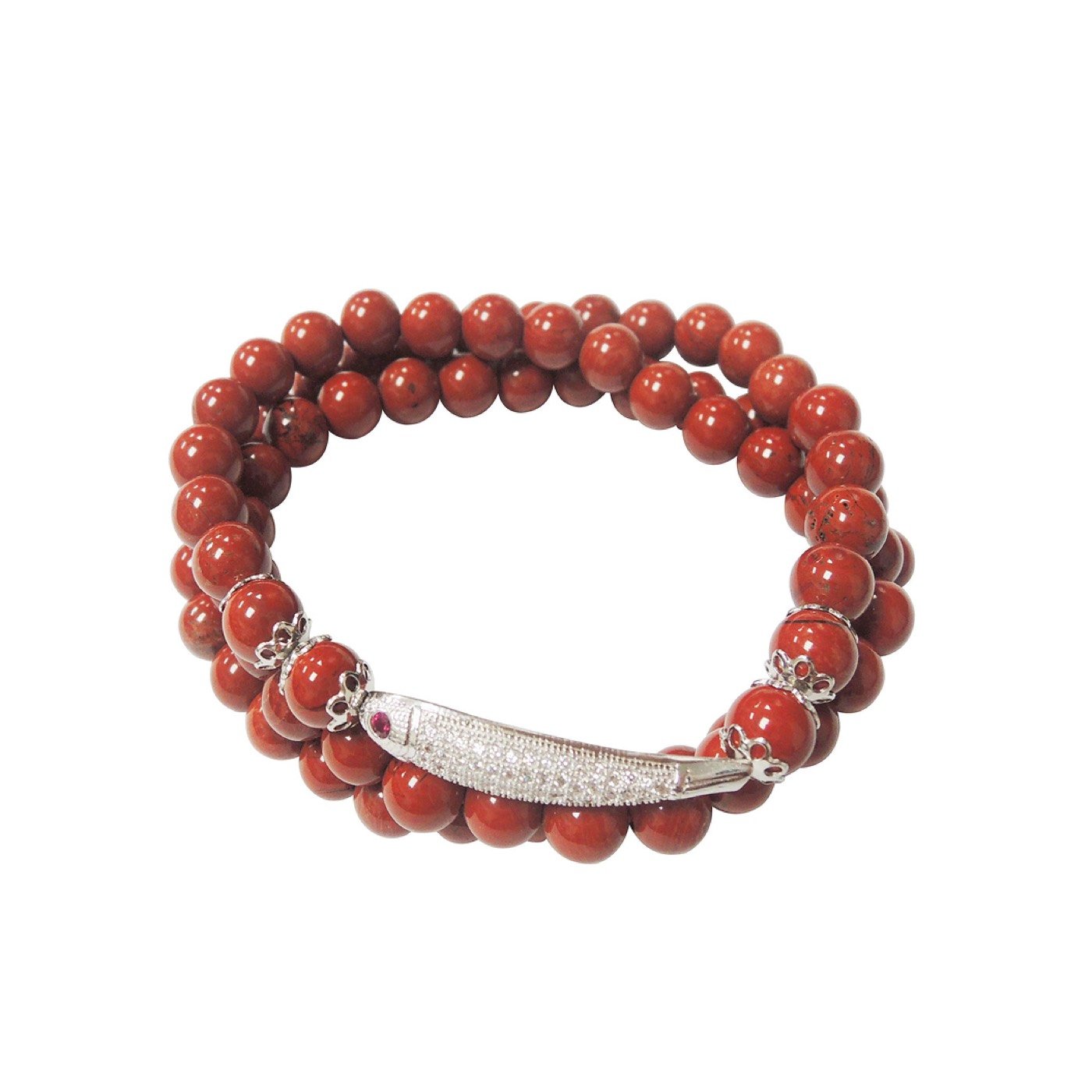
Red Bead Triple Strand Wrap Stretch Bead Bracelet Red Jasper with Fish Bead Jewelry

Forest Jasper Dangle Earrings Pearl Dangling Fashion Drop Earrings Round Jewelry

Forest Jasper Dangling Fashion Drop Earrings Round Jewelry

Forest Jasper Dangle Fashion Earrings Square Jewelry
Jasper FAQs
What is jasper stone?
Jasper is an opaque, microcrystalline quartz coloured by iron oxides, clay and other minerals. It belongs to the chalcedony family with agate and carnelian.
What is the difference between jasper and agate?
Agate is translucent and usually banded, while jasper is opaque. Both are chalcedony, and some stones show areas of each.
How can I tell if jasper is real?
Real jasper feels cool and heavy for its size and shows natural, irregular patterns. Even, bright colours in cracks suggest dye, and glass or plastic feels warmer and lighter.
Is bloodstone a type of jasper?
Yes, bloodstone is a dark green jasper with red spots, and it is a traditional birthstone for March.
Is jasper valuable?
Most jasper is affordable. Rare types, striking picture patterns and fine carving or cutting raise the value.
Checked against
Every fact on this page was checked against these references. Gem science moves on, so if you spot something out of date, tell us.
- Jasper Value, Price, and Jewelry InformationInternational Gem Society
- Buying Guide: Get to Know the Different Types of ChalcedonyGem-A
- Jasper gemstone informationGemdat.org
- JasperMinerals.net