Amazonite: a name with a mystery
The International Gem Society traces the link between this green stone and the Amazon back to 1701 or earlier. The German mineralogist August Breithaupt gave amazonite its formal name in 1847. Nobody is quite sure which green stones early travellers actually brought back from the region, and Geology.com notes that no known amazonite deposits lie near the river at all.
The stone itself is far older than its name. According to the IGS, people in Northern Africa, Mesopotamia and the Indus Valley were already cutting amazonite by around 5,200 BCE. Geology.com adds that it has turned up at archaeological sites in ancient Egypt and Mesopotamia.
A feldspar with a hidden ingredient
Amazonite is a green to blue-green variety of microcline, a potassium feldspar. That makes it a relative of moonstone and labradorite, even though it looks nothing like either.
Its colour puzzled mineralogists for a long time. The accepted explanation is surprising: traces of lead, together with water held in the crystal structure, are changed by natural radiation in the ground over geological time. A 2017 note in GIA's Gems & Gemology sums it up as structurally bound water and lead, followed by irradiation. Heat the stone strongly and the colour can fade away.
Most amazonite shows white streaks and a fine grid-like pattern. These are thin layers of another feldspar, albite, grown inside the microcline. They are a natural signature of the stone.
Where amazonite comes from
Teller County in Colorado is famous among collectors for amazonite crystals growing beside dark smoky quartz. Virginia, Brazil, Peru, Ethiopia, Madagascar and Russia all produce material too, and colour varies from a soft apple green to a cooler blue-green.
In the bead and cabochon trade, amazonite is valued as an affordable, natural green to sit beside jasper and agate. Clean, even, translucent pieces are much rarer than the mottled stones most people know.
The facts
- Mineral family
- Feldspar (microcline)
- Chemical formula
- KAlSi₃O₈
- Mohs hardness
- 6–6.5
- Refractive index
- 1.522–1.530
- Specific gravity
- 2.54–2.63
- Crystal system
- Triclinic
- Colours
- Green to blue-green, often with white streaks
- Main sources
- Brazil, Peru, USA (Colorado, Virginia), Ethiopia, Madagascar, Russia
- Birthstone
- —
- Common treatments
- Wax or resin impregnation, coatings, dyeing; irradiation is rare
What makes a good amazonite
Amazonite value rises with colour and clarity. The most prized stones show a saturated, even blue-green with some translucency and little white mottling. Most material is opaque and streaked, and it is priced accordingly. For beads and strands, look for a good colour match from bead to bead and clean, well-centred drill holes.
Be cautious with unusually vivid, glassy material at a low price. GIA has reported translucent blue amazonite beads that had been impregnated with resin, which hides fractures and improves the look. Treated material is fine to buy if it is disclosed, but it needs gentler care.
Cut also plays a part. Amazonite is almost always shaped as cabochons, beads and carvings, because its opacity and cleavage make faceting difficult. A good cabochon has a smooth, even dome with no flat spots, and the streaks run in a pleasing direction rather than cutting awkwardly across the face.
- Look for the natural white streaks and fine cross-hatch pattern of genuine amazonite
- Ask whether the stone has been impregnated, waxed or coated
- Very vivid, highly translucent blue material deserves a disclosure question
- "Amazon jade" is a misleading name: amazonite is a feldspar, not jade
- Check for flat, shiny cleavage breaks around drill holes and girdles
- Dyed imitations may show colour pooling in cracks
Keeping it beautiful
Amazonite sits at 6 to 6.5 on the Mohs scale and has perfect cleavage, so it can chip or split if knocked. It is happiest in earrings, pendants and beaded necklaces. In rings and bracelets, choose a protective setting. Resin-treated beads can be damaged by solvents such as acetone, so keep nail polish remover well away.
- Clean with a soft brush, mild detergent and warm water
- Never use ultrasonic or steam cleaners
- Keep away from acetone and other solvents
- Avoid strong heat, which can fade the colour
- Store separately from harder gems
Amazonite, from D’sire
At D’sire we have three decades of cutting and calibrating stones for the trade from Hong Kong. We can source amazonite and cut it to your sizes as cabochons, beads or strands, matched for colour, and bring it into private label or bespoke jewellery.

Howlite & Amazonite Knotted Necklace
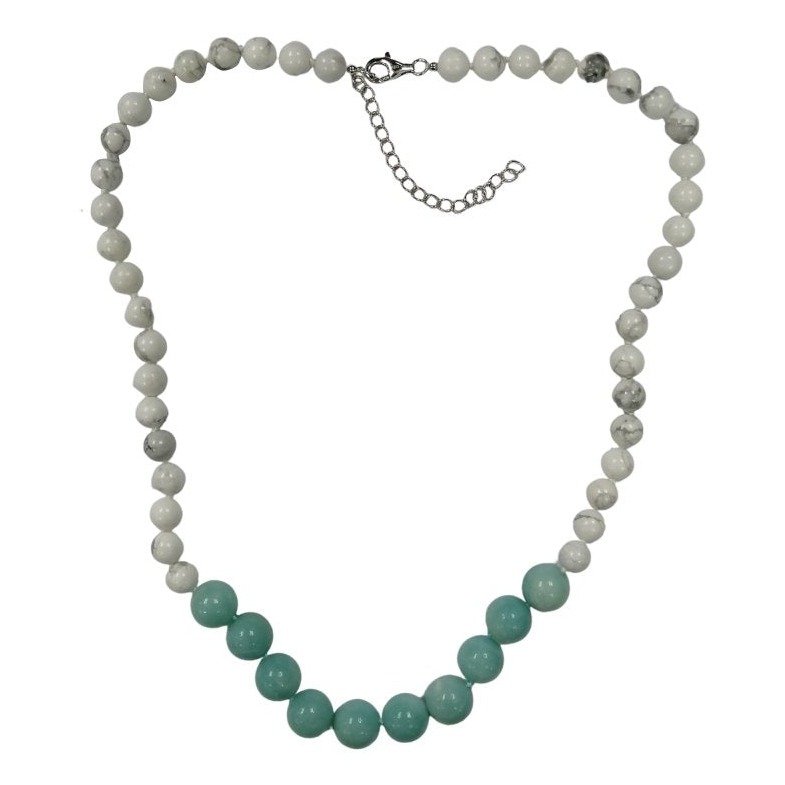
Howlite & Russian Amazonite Knotted Necklace


Unisex Multi Color Gemstone Stackable Bracelet Set of 3 Beaded Stretch Bracelets Gifts

Unisex Multi Color Gemstone Stackable Bracelet Set of 3 Beaded Stretch Bracelets Gifts

Unisex Multi Color Gemstone Stackable Bracelet Set of 3 Beaded Stretch Bracelets Gifts
Amazonite FAQs
What is amazonite stone?
Amazonite is a green to blue-green variety of microcline, a potassium feldspar. Its colour is linked to traces of lead and water in the crystal, changed by natural radiation.
Does amazonite come from the Amazon?
No known deposits exist near the Amazon River. The name has been attached to the stone since at least 1701 and was formalised in 1847.
How can I tell if amazonite is real?
Genuine amazonite usually shows white streaks and a fine grid pattern, with flat cleavage surfaces where chipped. Uniform glassy colour or dye in cracks suggests glass, dyed stone or treatment.
Is amazonite expensive?
Most amazonite is affordable. Value climbs for even, saturated blue-green colour with translucency, and for well-matched calibrated strands.
Can amazonite get wet?
Brief contact with water is fine and warm soapy water is the right way to clean it. Avoid soaking resin-treated stones and keep them away from solvents and steam.
Checked against
Every fact on this page was checked against these references. Gem science moves on, so if you spot something out of date, tell us.
- Amazonite Value, Price, and Jewelry InformationInternational Gem Society
- Impregnated AmazoniteGIA Gems & Gemology
- Amazonite gemstone informationGemdat.org
- Amazonite: a bluish-green microcline feldspar gemGeology.com