Carnelian beads in the royal tombs of Ur
In the 1920s a joint expedition of the British Museum and the University of Pennsylvania Museum excavated about 1,850 burials at Ur, in today's southern Iraq. According to the Penn Museum, sixteen were so rich they are called royal. Carnelian appears again and again, in headdresses and in long strings of beads.
Five beads in one string carry opaque white lines, made by a method typical of Indus Valley bead-makers of the time. Archaeologists read them as imports, a sign that carnelian was already travelling long trade routes four and a half thousand years ago. Few gemstones have such an old and well-documented trading history.
What gives carnelian its glow
Carnelian is a translucent orange to red variety of chalcedony, the microcrystalline quartz family that also includes agate, onyx and jasper. Its colour comes from tiny particles of iron oxide spread through the stone. Gemdat suggests the name probably comes from the cornel cherry, whose fruit shares the same warm red. In older British texts you will often see it spelled cornelian.
Heat changes it. Warming carnelian, even long exposure to sunlight, turns yellowish or brownish iron compounds redder. Bead-makers have used this for millennia, and the International Gem Society advises buyers to assume carnelian has been heated unless told otherwise. Gemdat goes further: much carnelian on the market is agate that has been dyed and heated.
Where carnelian darkens towards brown, it is called sard. Gem-A notes there is no clear dividing line between the two.
Where carnelian comes from today
India remains the main commercial source of carnelian today. Gem-quality material also comes from Brazil, Uruguay and Egypt, and collectors know smaller deposits in the United States.
The International Gem Society calls carnelian the best-known and generally least expensive variety of chalcedony. That makes it one of the most practical warm-coloured stones for beads, cabochons and carvings, and a good partner for gold.
Designers like it for its range. Pale, honey-orange stones read as soft and warm next to pearls and white metal, while deep red-orange carnelian holds its own beside yellow gold, garnet and black onyx. Because it is tough and has no cleavage, it can be cut into flat tablets, faceted beads and carved shapes that more fragile stones would not survive.
The facts
- Mineral family
- Quartz (chalcedony)
- Chemical formula
- SiO₂
- Mohs hardness
- 6.5–7
- Refractive index
- 1.535–1.539
- Specific gravity
- 2.58–2.64
- Crystal system
- Trigonal (microcrystalline)
- Colours
- Yellow-orange, orange, reddish orange to brownish red
- Main sources
- India, Brazil, Uruguay, Egypt, USA
- Birthstone
- —
- Common treatments
- Heating (routine, stable, undetectable); dyeing of pale agate
What makes a good carnelian
The best carnelian shows a saturated, even orange-red with a glowing translucency when light passes through it. Patchy colour, cloudy zones and strong white banding lower the value, although banded stones have their own charm and suit carvings. Because the material is affordable, cutting quality, matching and size do much of the work on price.
For strands, hold the whole length up to daylight. Good carnelian beads match in tone and translucency from end to end, with smooth, centred drill holes. For cabochons and rings, look for a clean, even dome and a bright polish.
- Hold it to the light: natural carnelian shows soft, cloudy colour variation
- Dyed agate may show colour concentrated in bands, cracks and drill holes
- Glass imitations often contain round bubbles and feel too uniform
- Assume heat treatment; it is standard and stable
- Banded white streaks suggest agate structure, not a fake
- Check that a matched strand holds the same tone end to end
Keeping it beautiful
Carnelian is hard, tough and has no cleavage, so it is one of the easiest gems to live with. It suits rings, bracelets and signet stones. Keep it out of harsh chemicals, and store dyed material out of strong sunlight for long periods. Beaded strands should be restrung every few years if worn often, because the thread wears long before the stone does.
- Clean with warm soapy water and a soft brush
- Avoid bleach, acids and solvents
- Store separately from diamonds and sapphires
- Avoid sudden extreme heat
Carnelian, from D’sire
With three decades of cutting and calibrating stones for the trade in Hong Kong, D’sire can source carnelian and cut it to your sizes as beads, calibrated cabochons, flat tablets and strands. We can also set it into private label or bespoke jewellery.

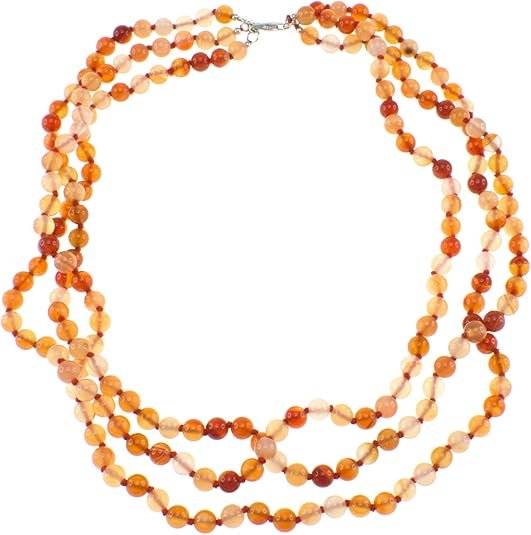
Carnelian Twisted Necklace 20″-21″
Enquire about this piece ↗
Natural Carnelian Gemstone Bracelet 7.5 inch 3-Line Round Beads
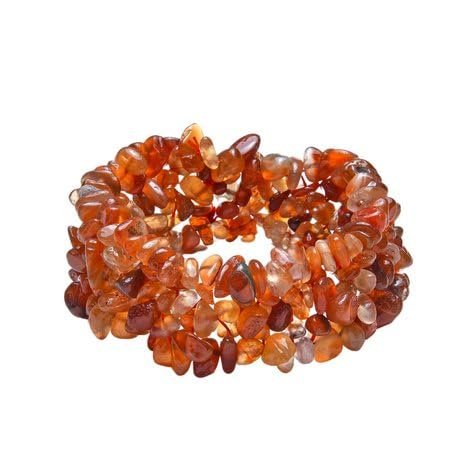
Natural Carnelian Gemstone Chips Stretch Bracelet

Natural Orange Carnelian Journey Beads Strand Necklace

Natural Gemstone Graduation Beads Beaded Strand Bracelet
Carnelian FAQs
What is carnelian stone?
Carnelian is a translucent orange to red variety of chalcedony, a form of quartz. Its colour comes from iron oxide spread through the stone.
Is carnelian heat treated?
Usually, yes. Heating turns yellowish or brownish chalcedony a richer orange-red, and it is a stable, traditional treatment that is very hard to detect.
How can I tell if carnelian is real?
Natural carnelian shows soft, uneven colour when held to the light. Even colour concentrated in cracks or bands suggests dye, and bubbles suggest glass.
What is the difference between carnelian and sard?
Sard is a darker, browner chalcedony. The two grade into each other and there is no fixed boundary.
Is carnelian expensive?
No. It is one of the most affordable chalcedonies. Prices rise for strong, even colour, high translucency, larger sizes and fine carving.
Checked against
Every fact on this page was checked against these references. Gem science moves on, so if you spot something out of date, tell us.
- Carnelian Value, Price, and Jewelry InformationInternational Gem Society
- Buying Guide: Get to Know the Different Types of ChalcedonyGem-A
- Carnelian gemstone informationGemdat.org
- Ur and Its Treasures: The Royal TombsPenn Museum, Expedition Magazine
- CarnelianGeology.com