The fingernail stone
Classic onyx is a chalcedony with straight, nearly parallel bands of black and white. Gemdat suggests the fingernail name may come from its limited transparency, like the pale edge of a nail. Its layers made it a favourite of cameo and intaglio carvers: cut through a white band to reveal the dark one beneath, and a profile appears in relief.
Imitation is nothing new. The Roman writer Pliny the Elder described craftsmen making convincing layered fakes. When the bands are reddish or brown under white, the stone is called sardonyx, the traditional birthstone for August.
How black onyx gets its colour
Most onyx sold today is not banded at all. It is chalcedony dyed a solid, even black. The usual method is simple and clever: greyish chalcedony is soaked in a sugar solution, then heated in sulphuric acid, which leaves fine carbon in the stone's tiny pores. The International Gem Society notes the black often penetrates only a few millimetres.
Gem-A records that some critics feel this material should really be called dyed black chalcedony. In practice, "black onyx" is the accepted trade name, and Gemdat states that black chalcedony sold as onyx can be assumed to be dyed. The result is stable, uniform and ideal for calibrated beads and inlay.
Black onyx had a moment in the 19th century, when Victorian mourning jewellery used it beside jet for rings, brooches and lockets. It has never really left the jeweller's bench since, from Art Deco geometry to modern men's signet rings.
Onyx that is not onyx
The name is used loosely. "Mexican onyx" and much decorative "onyx marble" are banded calcite or aragonite, softer minerals used for carvings, tiles and tabletops. They scratch easily and should not be confused with chalcedony onyx in jewellery.
True onyx is a member of the quartz family, alongside agate, carnelian and jasper. At around 7 on the Mohs scale it is hard enough for daily wear.
The facts
- Mineral family
- Quartz (chalcedony, variety of agate)
- Chemical formula
- SiO₂
- Mohs hardness
- 6.5–7
- Refractive index
- 1.530–1.543
- Specific gravity
- 2.55–2.70
- Crystal system
- Trigonal (microcrystalline)
- Colours
- Black, black and white banded, white; reddish-brown and white as sardonyx
- Main sources
- Brazil, Uruguay, India, Madagascar, Germany, USA
- Birthstone
- August (as sardonyx, traditional)
- Common treatments
- Dyeing (solid black onyx is routinely dyed), heating
What makes a good onyx
For black onyx, look for a deep, even, jet-black colour with no grey patches, and a mirror polish. Flat stones for signet rings and inlay should have crisp edges and true, level surfaces. For banded onyx and sardonyx, value comes from sharp contrast and straight, evenly spaced layers, and above all from the quality of any carving.
Onyx value as a material is modest. In most jewellery the metal, the cutting and the workmanship cost more than the stone itself. Antique hand-carved cameos and intaglios are a different story and should be judged as works of craft.
If you are planning a collection, think about consistency. Black onyx is popular precisely because batches can be matched closely, so beads, cabochons and inlay pieces look the same from one order to the next. Ask for calibrated sizes that fit standard settings, and check a sample under daylight before committing to volume.
- Assume solid black onyx is dyed; this is normal and should be disclosed
- Black glass often shows bubbles, mould marks or rounded edges
- Banded calcite "onyx" scratches with a steel point; true onyx does not
- Check chips at drill holes: grey or white inside means shallow dye
- For cameos, look for clean, deliberate relief and natural layering
- Black spinel, black cubic zirconia and glass are used as lookalikes
Keeping it beautiful
Onyx is hard and has no cleavage, so it handles daily wear well. Keep it away from strong acids and solvents, which can affect dyed material, and avoid ultrasonic cleaners. Long periods in strong sunlight can fade some dyed stones.
- Clean with a soft brush, mild detergent and warm water
- Avoid ultrasonic cleaners and harsh chemicals
- Store away from harder gems to keep the polish
- Wipe after wear to remove skin oils and perfume
Onyx, from D’sire
Black onyx is a workhorse at the trade bench, and D’sire has three decades of cutting and calibrating stones for the trade in Hong Kong. We can source and cut onyx to your sizes as calibrated cabochons, flat tablets for signet rings, beads and strands, and bring it into private label or bespoke designs.
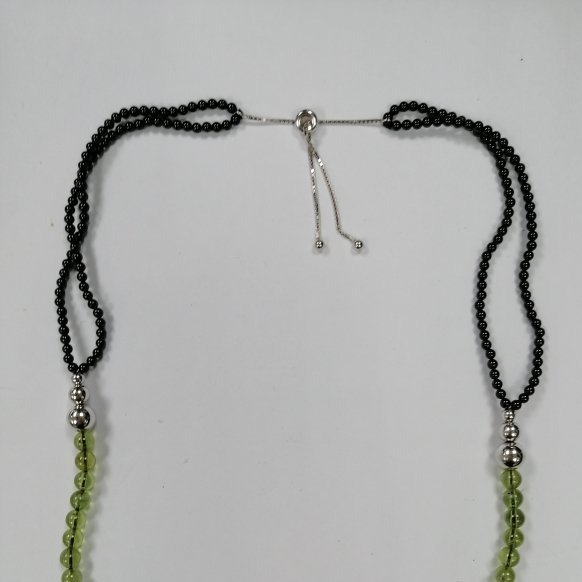


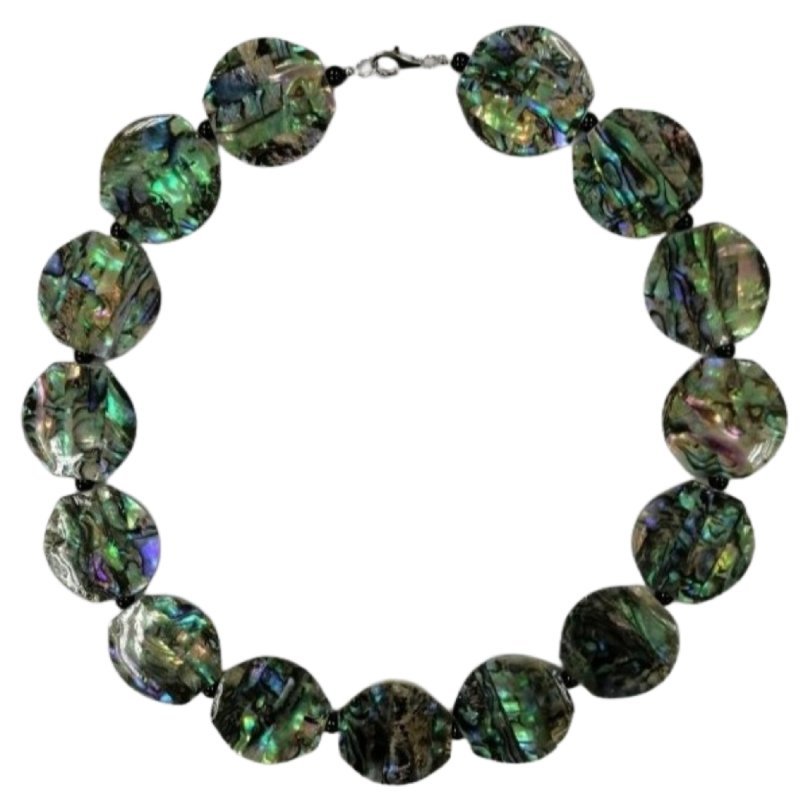

Onyx & Rose Quartz Necklace
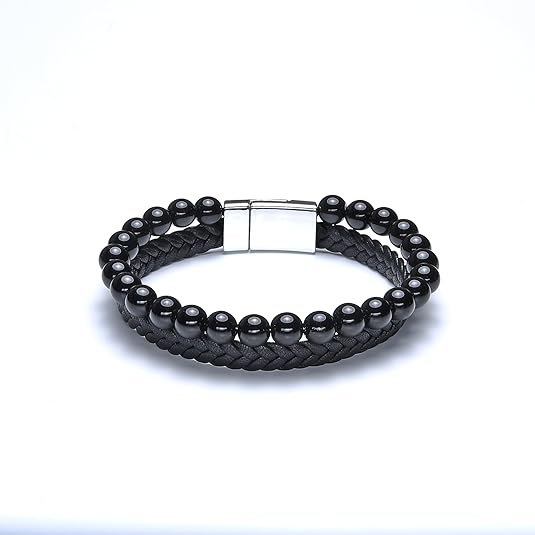
New Men’s Bracelet Bead and Leather Braided Gemstone Black Onyx 8mm Beaded Comfortable Lea
Enquire about this piece ↗Onyx FAQs
Is black onyx natural?
Black onyx is natural chalcedony, but its solid black colour is almost always produced by dyeing. This is a long-established, stable treatment and is standard in the trade.
What is onyx stone?
Onyx is a chalcedony with straight, parallel bands, traditionally black and white. The name is now also used for uniformly black chalcedony.
How can I tell if onyx is real?
Real onyx is hard, cool and takes a high polish, and it resists a steel point. Glass may show bubbles, and calcite "onyx" scratches easily.
What is the difference between onyx and sardonyx?
Sardonyx has reddish or brown bands, from sard, alternating with white. Classic onyx has black and white bands.
Is onyx good for men's rings?
Yes. Its hardness, toughness and deep black colour make it a long-standing choice for signet rings, as long as it is kept away from harder gems and harsh chemicals.
Checked against
Every fact on this page was checked against these references. Gem science moves on, so if you spot something out of date, tell us.
- Onyx Properties, Varieties, and Jewelry InformationInternational Gem Society
- Buying Guide: Get to Know the Different Types of ChalcedonyGem-A
- Onyx gemstone informationGemdat.org
- Sardonyx gemstone informationGemdat.org