The Anahí legend
The story is told in eastern Bolivia, near the Brazilian border. In the 1600s, it goes, the Ayoreo people gave a mine to a passing conquistador as a dowry when he married the chief's daughter, Anahí. He is said to have taken purple and gold crystals back to Spain as gifts for his queen, which is how ametrine first reached Europe.
Then the mine disappeared from the record for more than three hundred years. It was rediscovered in the 1960s, and ametrine reached the wider market in the 1970s. The mine today carries the princess's name.
It is not hard to see how it was lost. The Anahí mine sits in the Pantanal wetlands, reached by small plane or by river, lagoon and muddy forest road. Bolivian Express describes miners leaving offerings to El Tío, the spirit of the mine.
Smuggled stones and a mystery solved
For years ametrine's origin was a puzzle. Stones were smuggled into Brazil, cut there and sold with their source hidden, and rumours spread that the colours were made in a laboratory.
In late 1989 a change in Bolivian law gave a concession to the company Minerales y Metales del Oriente, which still runs the mine. In 1994 a study in GIA's Gems & Gemology confirmed that Anahí ametrine's colours are natural, not the result of treatment.
So what makes one crystal two colours? Ametrine is quartz with iron impurities. Small differences in temperature during growth left some zones purple, like amethyst, and others yellow to orange, like citrine.
Ametrine value: balance is everything
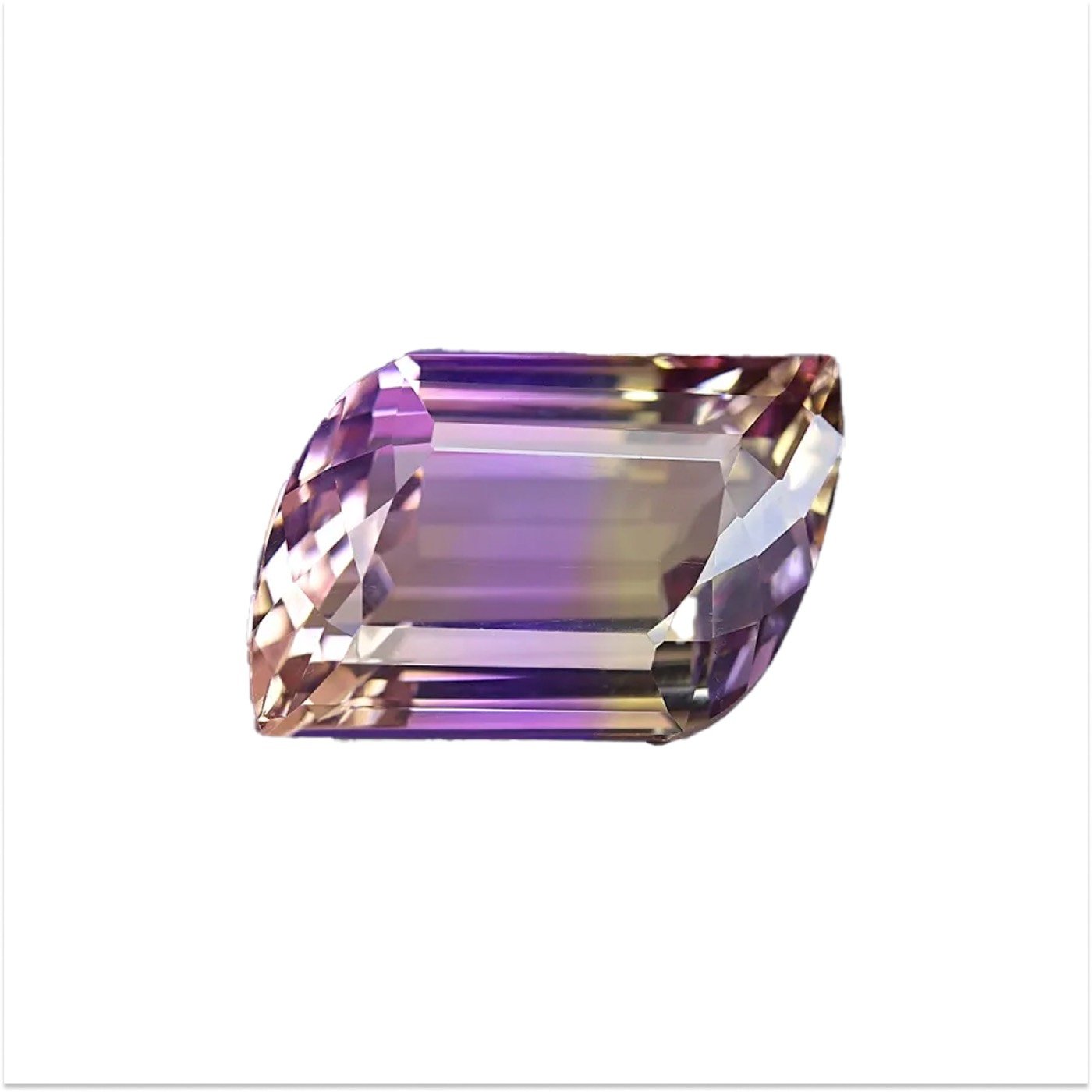
The most prized ametrine shows strong purple and warm gold in roughly equal measure, with a crisp line where they meet. Cutters usually choose long rectangles or emerald cuts so both colours sit side by side. Some stones are cut to blend the colours into a soft peach-lilac instead.
Because almost all of it comes from a single mine, supply is steady but limited. Even so, ametrine stays affordable compared with most bicolour gems, and its clarity is usually excellent.
Its two colours make it a natural fit for statement pendants and cocktail rings, where a larger stone gives both zones room to show.
The facts
- Mineral family
- Quartz
- Chemical formula
- SiO₂
- Mohs hardness
- 7
- Refractive index
- 1.544–1.553
- Specific gravity
- 2.65–2.66
- Crystal system
- Trigonal
- Colours
- Purple and yellow to orange zones in one stone; blended peach to lilac
- Main sources
- Bolivia (Anahí mine); minor finds elsewhere
- Birthstone
- —
- Common treatments
- Natural stones usually untreated; some ametrine is produced by treating or synthesising quartz
What makes a good ametrine
Look for saturated purple and gold, a clean division between them, and a cut that shows both. Pale or muddy colours where the zones overlap lower the value.
Synthetic ametrine and treated quartz are on the market and match natural stones in their basic properties. Only gem testing can separate them reliably, so buy from someone who will say where a stone came from. Our cut and polished gemstones page explains how we work with traceable parcels for the trade.
Think about the design before choosing a cut. A long bar shows the two colours as a clean split, which suits pendants and drop earrings. A round or checkerboard cut mixes them and reads as a warmer, softer colour from a distance. Matched pairs should share the same balance of purple and gold.
- Choose strong purple and gold in roughly equal parts
- Look for a crisp colour boundary, not a muddy middle
- Ask whether the stone is Bolivian and natural
- Very even, perfectly straight colour bands at a low price can point to synthetic
- Expect eye-clean stones; heavy inclusions are unusual
- Ask for lab testing on large or costly pieces
Keeping it beautiful
As quartz, ametrine is hard enough for daily wear and has no cleavage. It handles household chemicals and temperature changes better than many gems.
Strong heat can change its colours, so keep it away from a jeweller's torch during repairs and from long spells of direct sun.
Clean it like any quartz: warm water, a little soap and a soft brush. Dry it with a lint-free cloth before you put it away.
- Clean with warm soapy water and a soft brush
- Avoid strong heat and long direct sunlight
- Store away from harder gems that can scratch it
- Tell your jeweller it is ametrine before any repair
Ametrine, from D’sire
At our Hong Kong bench, ametrine is a favourite for showing what cutting can do, from classic bicolour bars to blended stones. We supply cut and calibrated ametrine and strands to the trade, and set it in private label and bespoke pieces. We can source and cut it to your sizes.

Sterling Silver Blended Ametrine Earrings

Sterling Silver Blended Ametrine Ring

Sterling Silver Bi-color Ametrine Ring

Sterling Silver Bi-Color Ametrine Ring

Sterling Silver Bi-color Ametrine Ring

Sterling Silver Bi-color Ametrine Ring
Ametrine FAQs
What is ametrine?
Ametrine is a natural quartz with zones of purple amethyst and yellow citrine in the same crystal. Almost all of it comes from the Anahí mine in Bolivia.
What does ametrine stone mean?
Its name blends amethyst and citrine. Its story is tied to the Bolivian legend of Princess Anahí, whose dowry was said to include the mine.
Is ametrine rare?
It comes from essentially one commercial mine, which makes it unusual, but production is steady, so it remains affordable compared with many gems.
Is ametrine real or man-made?
Natural ametrine exists and Bolivian stones were confirmed natural in a 1994 study. Synthetic and treated versions are also sold, so ask for origin and testing.
Is ametrine a birthstone?
It is not an official birthstone. Some people wear it for February because it contains amethyst, or for November because of its citrine.
Checked against
Every fact on this page was checked against these references. Gem science moves on, so if you spot something out of date, tell us.
- AmetrineGIA Gem Encyclopedia
- Ametrine History and LoreGIA
- The Anahí Ametrine Mine, Bolivia (Vasconcelos, Wenk & Rossman, 1994)GIA Gems & Gemology
- Ametrine Value, Price, and Jewelry InformationInternational Gem Society
- AmetrineGemdat.org
- True Bolivianite: The Story of AmetrineBolivian Express