A name from the Alps
Gemmologists call moonstone’s shimmer adularescence, from adularia, an older name for the stone. Adularia was named after Mt Adular, today known as the St Gotthard massif in Switzerland, one of the first places fine moonstone was found. So the word for one of the gem world’s most romantic effects comes from an Alpine mountain.
The moon connection is much older. In Hindu mythology moonstone was said to be made of solidified moonbeams. In India, merchants traditionally displayed it on a yellow cloth, yellow being a sacred colour. Elsewhere it was believed to bring good luck, and some thought that holding one in the mouth under a full moon could reveal the future.
Moonstone meaning in jewellery history
Moonstone had its great moment around 1900. Art Nouveau designers such as René Lalique and Louis Comfort Tiffany loved its soft, milky light, which suited their flowing, nature-inspired forms better than hard, bright gems. Arts and Crafts makers of the same era set it in handmade silver.
It came back again in the 1960s and in the 1990s, and it has never really gone away. Today moonstone is one of the June birthstones, alongside pearl and alexandrite. In Germany and Scandinavia it is often the preferred June stone.
Where it comes from has shifted too. Myanmar once produced the finest blue-sheen moonstone, but those deposits are now largely worked out. Today most fine material comes from Sri Lanka and India, with Madagascar and Tanzania adding to supply. Sri Lankan moonstone tends to have a slightly lower density than Indian material, a small clue gemmologists note when testing.
How the glow works, and the rainbow question
Moonstone is a feldspar. As it cools deep underground, two feldspars, orthoclase and albite, separate into extremely thin alternating layers. Light scatters between those layers and produces the billowing glow. The thinner and more even the layers, the bluer and stronger the effect.
Rainbow moonstone is a slightly different stone. It is a type of labradorite, a related feldspar, with a light body colour and flashes of blue, green and orange. The trade has accepted the name. In 2024 GIA’s journal Gems & Gemology reported unusually transparent rainbow moonstone from Andilamena in Madagascar, clear enough to be faceted rather than cut as a cabochon.
The facts
- Mineral family
- Feldspar (orthoclase intergrown with albite)
- Chemical formula
- KAlSi₃O₈
- Mohs hardness
- 6–6.5
- Refractive index
- 1.518–1.526
- Specific gravity
- 2.56–2.59
- Crystal system
- Monoclinic
- Colours
- Colourless, white, grey, peach, green, brown; blue or white sheen
- Main sources
- Sri Lanka, India, Madagascar, Tanzania; historically Myanmar
- Birthstone
- June (with pearl and alexandrite)
- Common treatments
- Usually untreated; occasionally a dark backing coat to boost the sheen
What makes a good moonstone
The most valuable moonstone has a near-colourless, transparent body with a strong blue sheen that appears across the whole stone, not just at one edge. Silvery or white sheen is more common and more affordable. Fine blue-sheen stones are rarely large, and anything over 15 to 20 carats is unusual.
Cut matters a great deal. Moonstone is almost always cut as a cabochon, and the dome must be oriented so the glow sits in the centre as you look down on it. Small tension cracks called “centipedes” are typical inclusions; visible ones lower the value. For calibrated cabochons and beads, see our cut and polished gemstones and strands and beads.
- Look for a glow that moves and floats as you tilt the stone
- Choose a clear body with blue sheen centred in the dome
- Check under a loupe for centipede inclusions, a sign of natural moonstone
- Milky glass and chalcedony imitations show a flat, even colour with no moving light
- Ask whether the back has been coated, which can be scratched off
Keeping it beautiful
Moonstone is fairly soft and has two directions of easy cleavage, so a sharp knock can split it. It is lovely in earrings and pendants; in rings, choose a protective bezel and take it off for sport or heavy work.
- Clean with warm soapy water and a soft brush
- Never use ultrasonic or steam cleaners
- Avoid knocks and sudden temperature changes
- Store in a soft pouch, away from harder gems
Moonstone, from D’sire
Moonstone suits designers who want softness rather than sparkle. From our Hong Kong bench, drawing on three decades of sourcing and cutting, we can source and cut it to your sizes as calibrated cabochons or strands for private label lines, and set it in bespoke pieces.


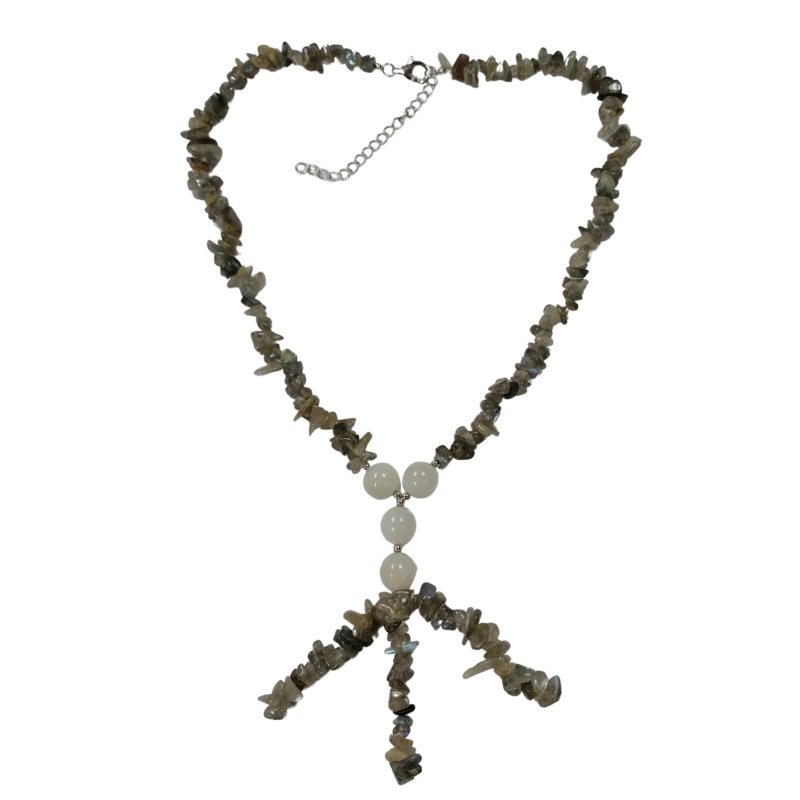
Labradorite & Moonstone Tassel Necklace

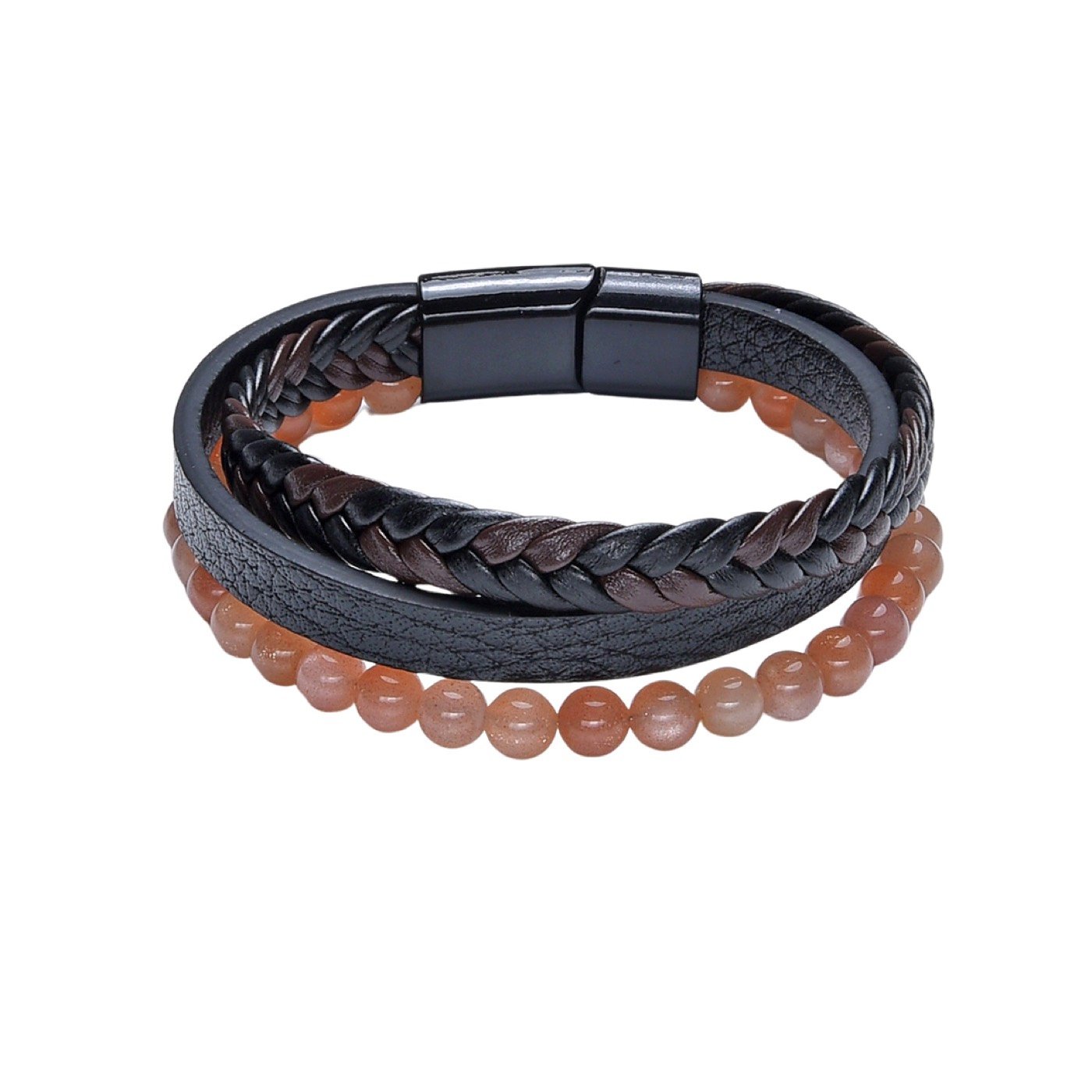
New Mens Bead and Leather Braided Peach Moonstone Jewelry Accessory Gift Bracelet
Enquire about this piece ↗
NMoonstone Journey Fashion Necklace White Jewelry for Women
Moonstone FAQs
What does moonstone mean?
Moonstone is a June birthstone. Its name and folklore come from its moon-like glow; in Hindu mythology it was said to be made of solidified moonbeams.
Is moonstone valuable?
Most moonstone is affordable. Clear stones with a strong, even blue sheen are much rarer and can command far higher prices, especially in larger sizes.
Is rainbow moonstone real moonstone?
Technically no. Rainbow moonstone is a variety of labradorite, a related feldspar, but the trade name is widely accepted.
How can you tell if moonstone is real?
Real moonstone has a glow that moves as you tilt it, and often shows tiny centipede-like inclusions. Glass and chalcedony imitations look flat and evenly milky.
Can you wear moonstone every day?
It is best for earrings and pendants. At 6 to 6.5 on the Mohs scale with easy cleavage, it needs a protective setting in a ring worn daily.
Checked against
Every fact on this page was checked against these references. Gem science moves on, so if you spot something out of date, tell us.
- MoonstoneGIA Gem Encyclopedia
- Moonstone History and LoreGIA
- New High-Quality Rainbow Moonstone from MadagascarGIA Gems & Gemology
- Moonstone Value, Price, and ColorInternational Gem Society
- Moonstone Symbolism and LegendsInternational Gem Society
- Moonstone gemstone informationGemdat.org