When pearls were worth a house
Pearls have one of the longest written histories of any gem. A Chinese historian recorded them as early as 2206 BC, and for thousands of years natural pearls were a sign of wealth and rank. The great sources were the Persian Gulf, the waters around Sri Lanka, Chinese waters and the rivers of Europe.
Then the supply ran out. Columbus’s later voyages opened up rich pearl beds off present-day Venezuela and Panama, and demand in Europe soared. Within a century those beds were overfished. By the early 1900s a fine natural strand was so rare that it could be swapped for a Manhattan townhouse.
Natural vs cultured pearls: how Japan changed everything
A natural pearl forms when a mollusc coats a tiny irritant with layer upon layer of nacre, the same material as mother-of-pearl. It happens by chance and only rarely. A cultured pearl forms the same way, except that a person places a bead or a piece of tissue inside the mollusc to start it off.
Kokichi Mikimoto began experimenting at Ago Bay in Japan around 1890 and produced his first cultured pearls in 1893. By the 1920s Japanese cultured pearls were an important trade, and from the 1930s pearl farming spread around the world. The pearls in almost all jewellery today are cultured, and they are real pearls grown by real molluscs.
Telling the two apart takes a laboratory. Gem labs such as SSEF use X-rays and even 3D scanning to see inside a pearl and look for the bead or growth pattern that reveals its origin.
The four pearls you will meet
Akoya pearls, from Japan and China, are the classic round white pearl with a sharp, mirror-like lustre. South Sea pearls are the largest, in white, silver and gold. Tahitian pearls are the naturally dark ones, in shades of grey, green, aubergine and peacock.
Freshwater pearls, grown mostly in China, come in the widest range of shapes and soft natural colours, from white and pink to lavender. They are the most affordable and a favourite for strands and beads and for brands building a first jewellery range. A single strand also makes one of the easiest necklaces to wear every day.
The facts
- Mineral family
- Organic gem (aragonite and conchiolin)
- Chemical formula
- CaCO₃ with organic conchiolin
- Mohs hardness
- 2.5–4.5
- Refractive index
- 1.53–1.69
- Specific gravity
- About 2.60–2.78
- Crystal system
- Not applicable (microcrystalline aragonite layers)
- Colours
- White, cream, pink, lavender, gold, grey, black, green, blue
- Main sources
- Cultured: China, Japan, Australia, Indonesia, the Philippines, French Polynesia; natural: historically the Persian Gulf and Sri Lanka
- Birthstone
- June (with moonstone and alexandrite)
- Common treatments
- Bleaching, dyeing, irradiation
What makes a good pearl
GIA judges pearls on seven value factors: size, shape, colour, lustre, surface, nacre quality and matching. Lustre matters most to the eye. A fine pearl shows sharp, bright reflections, almost like a mirror, while a poor one looks chalky. Round pearls are the most valued, though symmetrical drops and baroque shapes have their own following.
For a strand, look at how well the pearls match in size, colour and lustre. For a cultured pearl, thick nacre means it will last. If you are planning a private label pearl line, matching across many pieces is where an experienced supplier earns its keep.
- Look for bright, sharp reflections rather than a dull or chalky surface
- Rub gently against your teeth: real pearls feel slightly gritty, most fakes feel smooth
- Check around the drill hole for thin nacre, chipping or dye collecting
- Imitations are glass, shell or plastic with a coating, and often feel too light or too perfect
- For natural pearls, insist on a report from a recognised gem lab
Keeping it beautiful
Pearls are soft, and acids, perfume and hairspray can dull them. The old rule still works: last thing on, first thing off. Strands should be restrung every few years if worn often, as silk thread stretches and weakens. If you have inherited a strand, our heirloom care team can help bring it back into use.
- Put pearls on after perfume, make-up and hairspray
- Wipe with a soft damp cloth after wearing
- Never use ultrasonic or steam cleaners, or soak them
- Store flat in a soft pouch, apart from other jewellery
- Have strands restrung when the thread looks stretched
Pearl, from D’sire
At our Hong Kong bench, with three decades in the trade, pearls appear in everything from strands for jewellery brands to bespoke pieces and remade heirlooms. We can source and match pearls to your sizes for private label collections.


Women’s Natural Pearl Flower Ring

Ladies White Freshwater Pearl & Topaz Ring

Ladies Natural White Pearl & White Topaz Cocktail Ring

Ladies Natural White Pearl & Topaz Cocktail Ring
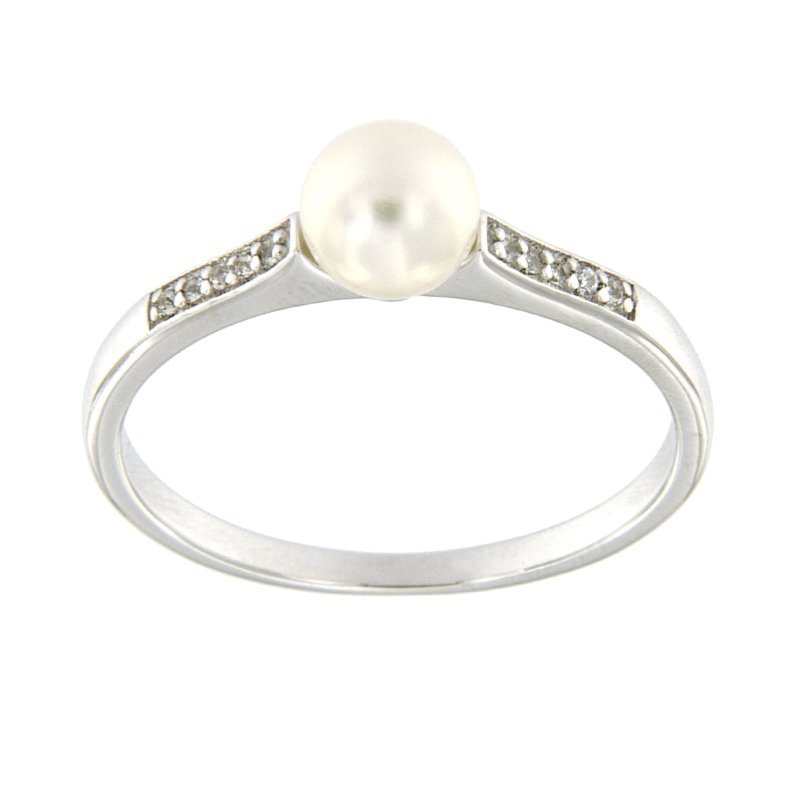
Ladies Natural White Freshwater Pearl & Topaz Ring
Pearl FAQs
What do pearls symbolise?
Pearl is the June birthstone and the gem for third and thirtieth wedding anniversaries. Many cultures linked pearls to the moon, and in Europe they long stood for purity and modesty.
Are cultured pearls real pearls?
Yes. Cultured pearls are grown by living molluscs and are made of real nacre. The only difference is that people start the process, rather than chance.
How can you tell if pearls are real?
Rub them gently against your teeth: real pearls feel slightly gritty, imitations feel smooth. Look at the drill hole too, and use a gem lab for anything valuable.
Which pearls are the most valuable?
Natural pearls are by far the rarest and most valuable. Among cultured pearls, large, round South Sea and fine Tahitian pearls usually cost the most.
Can you wear pearls every day?
Yes, with care. Keep them away from perfume and chemicals, wipe them after wearing, and have strands restrung regularly.
Checked against
Every fact on this page was checked against these references. Gem science moves on, so if you spot something out of date, tell us.
- PearlGIA Gem Encyclopedia
- Pearl History and LoreGIA
- Japanese Cultured Pearls Reading ListGIA
- Pearl Value, Price, and Jewelry InformationInternational Gem Society
- X-ray computed microtomography: distinguishing natural pearls from beaded and non-beaded cultured pearlsSSEF