The island of snakes
The ancient Egyptians mined peridot on Zabargad, a small island in the Red Sea also known as St John’s Island. In ancient times the island was called Topazios, and the green stones from it were often labelled “topaz”, which has confused gem names ever since. A legend says a pharaoh had to drive out the snakes that made mining there so difficult.
Egyptians called peridot the gem of the sun. Some historians even think Cleopatra’s famous emerald collection may have been peridot. Many of the large, fine peridots in today’s museums came from that one island.
Peridot stone meaning: a gem from deep inside the Earth
Peridot is the gem variety of olivine, a mineral that forms in the Earth’s upper mantle, far below the crust. Most of it reaches the surface carried up by volcanic activity, which is why it turns up in lava and in mantle rock called peridotite. The name itself is usually traced to Arabic.
Its colour comes from iron, built into the crystal rather than added as a trace impurity. That is why peridot is always some shade of green, from yellowish lime to deep olive, and why the most iron-rich stones lean brown. Unlike many green gems, it does not come in a rainbow of other colours.
Look closely through a faceted peridot and you may see every back facet doubled. Its double refraction is strong enough that you can see two of each back facet when you look closely, and it is one of the simplest clues a gemmologist uses to separate it from green glass or emerald.
Older than the Earth itself
A tiny amount of peridot is not from this planet at all. Pallasite meteorites contain olivine crystals that date back to the formation of the solar system, which makes them some of the oldest material anyone can hold. Olivine was also found in comet dust brought back to Earth by NASA’s Stardust probe.
Space peridot is extremely rare, and you will not find it in an ordinary jewellery shop. The peridot in most jewellery today comes from Arizona, Myanmar, Pakistan, China and Vietnam. Myanmar’s Mogok area is known for large, fine stones, while Arizona produces plenty of smaller ones, ideal for beads and strands and calibrated melee.
The facts
- Mineral family
- Olivine (forsterite–fayalite series)
- Chemical formula
- (Mg,Fe)₂SiO₄
- Mohs hardness
- 6.5–7
- Refractive index
- 1.65–1.69
- Specific gravity
- 3.27–3.48 (typically about 3.34)
- Crystal system
- Orthorhombic
- Colours
- Yellowish green, lime green, olive green, brownish green
- Main sources
- Arizona (USA), Myanmar, Pakistan, China, Vietnam; historically Zabargad, Egypt
- Birthstone
- August
- Common treatments
- Usually untreated
What makes a good peridot
The most valued peridot is a pure, slightly yellowish green with no brown tint. Strong brown or very pale stones sell for less. Small stones are common, but large clean stones are much scarcer, so price per carat rises quickly with size.
Clarity matters too. Peridot often contains small, round “lily pad” inclusions, flat discs of liquid and gas around a tiny crystal. A few are normal and can help prove a stone is natural, but heavy inclusions lower brilliance. For loose and matched stones, see our cut and polished gemstones.
- Look for a lively green without brown or grey
- Check under a loupe for doubled back facets, a sign of real peridot
- Lily pad inclusions point to natural peridot; tiny round bubbles suggest glass
- Green glass is the most common imitation, so ask for a test on larger stones
- Peridot is almost never treated, so a claim of “enhanced colour” is a warning sign
Keeping it beautiful
Peridot is reasonably hard but can scratch with everyday wear, and it is sensitive to acids, including perspiration over long periods. It can also develop stress cracks, so protective settings make sense for rings and bracelets. Earrings and pendants, which take fewer knocks, are the easiest way to wear it every day.
- Clean with warm soapy water and a soft brush
- Avoid ultrasonic and steam cleaners
- Keep away from acids and household chemicals
- Choose bezel or protective settings for rings worn daily
- Store separately from harder gems
Peridot, from D’sire
Peridot is a favourite for summer collections and August birthstone lines. From our bench in Hong Kong we supply calibrated stones and strands to the trade, and we can source and cut it to your sizes for private label or bespoke work.

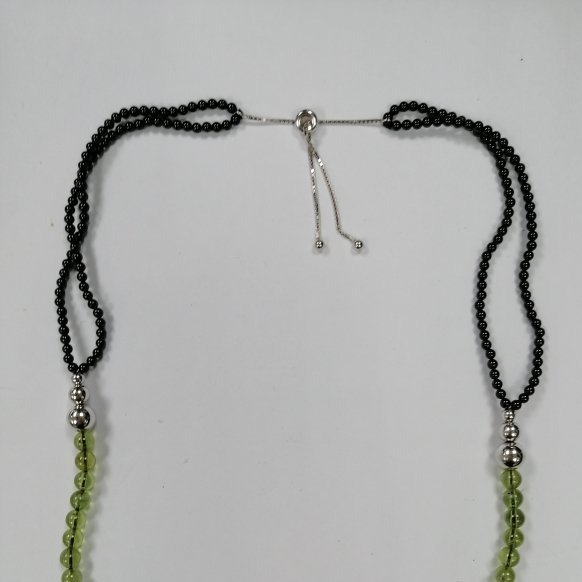


Natural Peridot 3-Line Necklace 18″
Enquire about this piece ↗
Natural Peridot Triple Strand Chip Fashion Necklace

Peridot FAQs
What does peridot stone mean?
Peridot is the birthstone for August and the gem for a fifteenth wedding anniversary. Ancient Egyptians called it the gem of the sun, and that sunny association has stayed with it.
Is peridot valuable?
Most small peridot is affordable. Large, clean stones with a pure green colour are much rarer and priced accordingly.
How can you tell if peridot is real?
Real peridot is strongly double refractive, so back facets look doubled under a loupe. Glass imitations are single refractive and often show round gas bubbles.
Can peridot be worn every day?
Yes, with some care. At 6.5 to 7 on the Mohs scale it can scratch, so pendants and earrings are easiest, and rings benefit from a protective setting.
Does peridot come from meteorites?
A tiny amount does. Pallasite meteorites contain gem olivine, but it is extremely rare and almost all peridot in jewellery is mined on Earth.
Checked against
Every fact on this page was checked against these references. Gem science moves on, so if you spot something out of date, tell us.
- PeridotGIA Gem Encyclopedia
- Peridot History and LoreGIA
- Peridot Value, Price, and Jewelry InformationInternational Gem Society
- Peridot gemstone informationGemdat.org