
From an Indian river to a museum case
The stone we now call the Hope Diamond came from the Kollur mine in India. Jean-Baptiste Tavernier, a French gem trader, bought it in the 17th century and sold it to Louis XIV in 1669. It was recut, changed hands many times, and took the name of the Hope family who owned it in the 1800s.
In 1911 the American socialite Evalyn Walsh McLean bought it. In 1958 the jeweller Harry Winston gave it to the Smithsonian, where it still sits today: 45.52 carats of dark greyish blue. You can trace its owners on the Gemdat record for the Hope Diamond.
Most diamonds never become famous. But every one starts the same way, as carbon squeezed deep in the earth and carried up by volcanic rock, then found, cut and passed from hand to hand.
How diamond became the stone of promises
For centuries India was the only source. Diamonds were gathered from rivers and streams, and trading may have begun as early as the fourth century BC. The Roman writer Pliny called diamond the most valuable of all things in the world.
When Indian supply faded in the early 1700s, miners in Brazil found diamonds in their gold pans, and Brazil led the market for over 150 years. Then in 1866 diamonds turned up near Kimberley in South Africa. Cecil Rhodes founded De Beers in 1888, and the modern diamond trade was born.
Diamond is pure carbon, the only gem made of a single element, and the hardest natural material. That hardness is why it became the stone for engagement rings: it is made to be worn every day for a lifetime.
Diamond value: what the 4Cs actually mean
In the 1950s the Gemological Institute of America set out the 4Cs: colour, clarity, cut and carat weight. Colour runs from D (colourless, the rarest) to Z (light yellow or brown). Clarity has 11 grades, from Flawless to Included, judged at ten times magnification.
Cut is the one people underrate. Good proportions and polish decide how much light comes back to your eye, so a well-cut stone can look brighter than a heavier, poorly cut one. Carat is weight, not size: one carat is 0.2 grams. Our grams to carats converter helps when you are weighing loose stones.
Natural colour diamonds, in blue, pink, yellow and green, are judged mostly on the strength of their colour, and the finest are among the most valuable things on earth.
The facts
- Mineral family
- Diamond (native carbon)
- Chemical formula
- C
- Mohs hardness
- 10
- Refractive index
- 2.417–2.419
- Specific gravity
- 3.51–3.53
- Crystal system
- Cubic
- Colours
- Colourless to light yellow and brown; rare natural blue, pink, green, orange, red and black
- Main sources
- Russia, Botswana, Canada, South Africa, Angola, Namibia, DR Congo, Australia
- Birthstone
- April
- Common treatments
- Laser drilling, fracture filling, HPHT, irradiation and annealing, coating
What makes a good diamond
Decide what matters to you first. For brightness, put cut first. For a stone that looks white in its setting, a G or H colour is often hard to tell apart from a D once mounted. Most buyers choose clarity that looks clean to the naked eye rather than paying for a flawless grade.
Ask whether the stone is natural or lab-grown. Lab-grown diamonds are real diamond, grown by HPHT or CVD methods, and they need lab testing to identify. Both are honest choices if they are clearly described. For anything over a carat, ask for an independent grading report, and if you already own a piece and want to know what it is, our appraisal service can help.
- Ask for a grading report from an independent lab for larger stones
- Ask in writing whether the stone is natural or lab-grown
- Ask about treatments: fracture filling and coatings are not permanent
- Look at the stone in daylight and in shade, not only under shop lights
- Cubic zirconia is much heavier than diamond; moissanite shows doubled facet edges under a loupe
- Lab-grown and natural can look identical, so ask for paperwork
Keeping it beautiful
Diamond is the hardest gem, but it is not unbreakable. A hard knock on the right angle can chip it, and it attracts grease, which dulls the sparkle. A gentle clean every few weeks brings it back.
Store diamonds apart from other jewellery, because a diamond will scratch softer stones and even other diamonds. If a ring has worn thin over the years, the stones can often be reset in heirloom remaking.
- Clean with warm water, mild soap and a soft brush
- Keep each piece in its own pouch or compartment
- Take rings off for gardening, gym work and heavy lifting
- Avoid ultrasonic cleaners for fracture-filled stones
- Have prongs checked once a year
Diamond, from D’sire
Over three decades in Hong Kong, we have set diamonds alongside coloured stones in private label collections and bespoke pieces. We can source diamonds to your sizes for a jewellery line, and we often reuse diamonds from older pieces when remaking heirlooms.

Red Labradorite and Diamond 10k Gold Pendant

Red Labradorite and Diamond 10k Gold Pendant
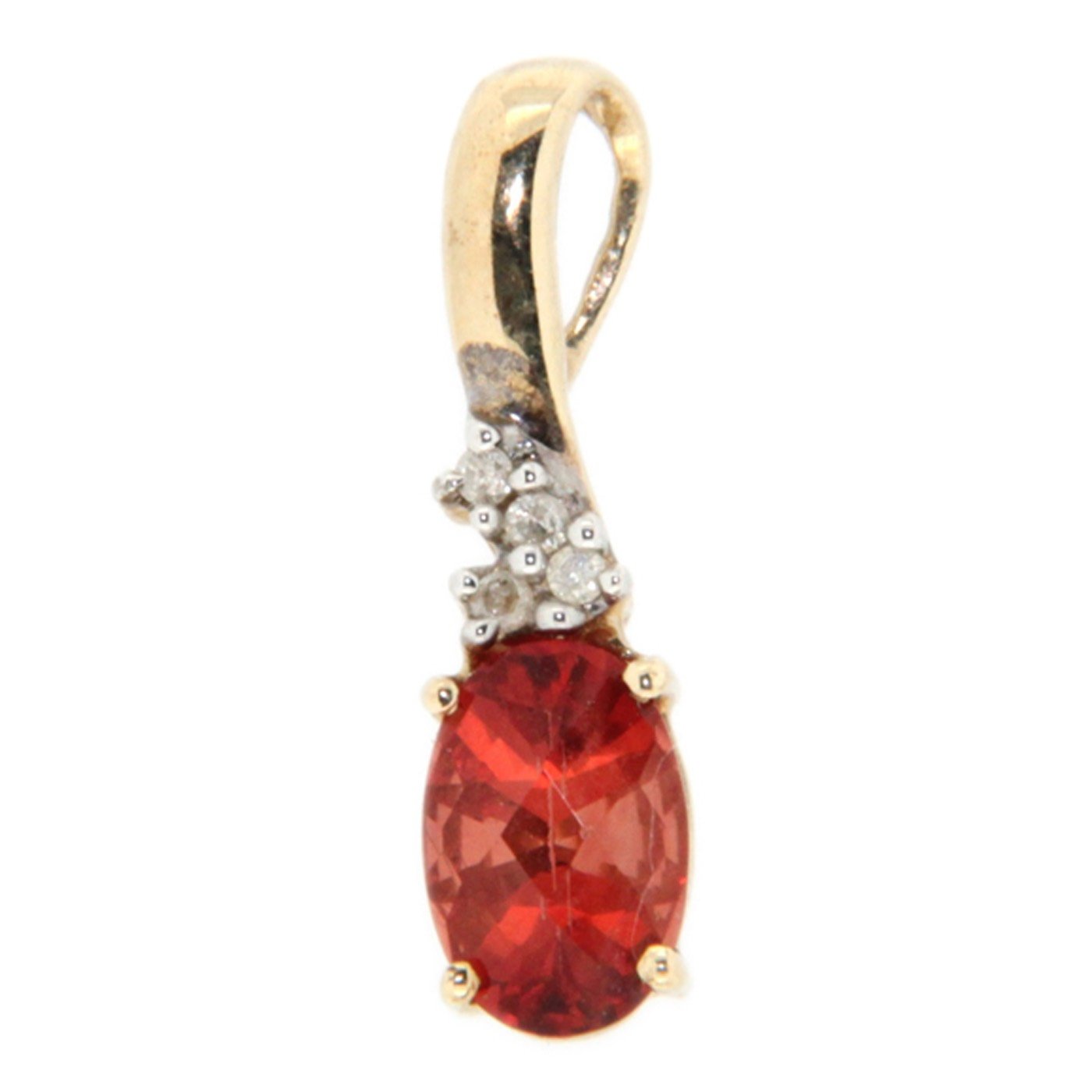
Red Labradorite and Diamond 10k Gold Pendant

Red Labradorite and Diamond 10k Gold Pendant

Red Labradorite and Diamond 10k Gold Pendant

Red Labradorite and Diamond 10k Gold Pendant
Diamond FAQs
What does a diamond mean?
Diamond has stood for commitment and endurance for centuries, partly because it is the hardest natural material. It is the April birthstone and the stone for 60th and 75th anniversaries.
How can I tell if a diamond is real?
A loupe helps: moissanite shows doubled facet edges and cubic zirconia is far heavier for its size. The only reliable answer, especially for lab-grown versus natural, comes from a gem lab.
Is a lab-grown diamond a real diamond?
Yes. It is the same carbon crystal with the same hardness and sparkle, grown in a factory by HPHT or CVD rather than mined. It should always be sold as lab-grown.
Which of the 4Cs matters most for diamond value?
All four set the price, but cut has the biggest effect on how bright the stone looks. Colour and clarity are often hard to see once a diamond is set.
Why do diamonds get cloudy?
Usually it is skin oil, soap and lotion on the back of the stone. A soak in warm soapy water and a soft brush will clear it.
Checked against
Every fact on this page was checked against these references. Gem science moves on, so if you spot something out of date, tell us.
- DiamondGIA Gem Encyclopedia
- Diamond History and LoreGIA
- Diamond Quality FactorsGIA
- Diamond TreatmentsGIA 4Cs
- HPHT and CVD Diamond Growth ProcessesGIA
- Diamond Lookalikes Listed by Specific GravityInternational Gem Society
- Hope DiamondGemdat.org