The oldest gem mines on record
Historians believe people have treasured lapis lazuli for more than 6,500 years. Its home is Badakhshan, in the mountains of north-east Afghanistan. GIA describes the mines there as the world’s oldest known commercial gemstone sources, already working in the time of ancient Bactria.
From those valleys, merchant caravans carried the blue stone to Egypt, Mesopotamia, Persia, India and Greece. It became game boards, bowls, dagger handles, combs and amulets. Lapis is set into the gold burial mask of Tutankhamun, where it outlines the young king’s eyes and brows.
The name tells the same story of travel. Lapis is Latin for stone, and lazuli comes through medieval Latin from the Persian name for the stone and its blue.
Lapis lazuli and the price of blue
For centuries, the finest blue paint in Europe was ground lapis. Painters called it ultramarine, meaning “beyond the sea”, because the stone came from so far away. It was one of the costliest pigments a painter could buy, so it was often saved for the robes of the Virgin and for skies that had to glow.
In Titian’s Bacchus and Ariadne, the sky and Ariadne’s robe are painted in it. The National Gallery in London describes the painting’s vast expanses of ultramarine, made from crushed lapis lazuli. Vermeer used it too. Only in the 1820s did chemists in France produce a synthetic ultramarine, and the old monopoly of the mountain mines ended.
A rock, not a single crystal
Unlike sapphire, lapis is not one mineral. It is a rock, a mix of several minerals. The blue comes from lazurite. White veins and patches are calcite, and the golden sparkles are pyrite, an iron mineral. Small amounts of diopside, mica or feldspar can also be present.
That mix explains everything a buyer needs to know. More lazurite means deeper blue and higher value. More calcite means paler, greyer stone. A little pyrite is loved; too much makes the stone look dull and greenish.
The facts
- Mineral family
- Rock: mainly lazurite (sodalite group) with calcite and pyrite
- Chemical formula
- Variable (a rock, not a single mineral)
- Mohs hardness
- 5–6
- Refractive index
- About 1.50 (aggregate)
- Specific gravity
- About 2.7–2.9 (higher with more pyrite)
- Crystal system
- None as a rock (lazurite is cubic)
- Colours
- Greenish blue to violetish blue; deep royal blue is most prized
- Main sources
- Afghanistan (Badakhshan), Pakistan, Chile, Russia
- Birthstone
- —
- Common treatments
- Dyeing, wax or oil impregnation, resin stabilisation
What makes a good lapis lazuli
Colour is almost everything. The finest lapis lazuli is an even, intense royal blue, often with a light dusting of gold pyrite and little or no white calcite. Stones with heavy white veining, grey patches or a greenish cast sit lower in value. In a strand, expect slight shifts in tone from bead to bead: that variation is a sign of natural stone, not a fault. For matched sets, the cutter selects rough from the same parcel so the blues sit together.
Dyeing is common, so ask. Paler lapis is often dyed to look richer, then sealed with wax or resin. For beads and finished strands, see our gemstone strands and beads.
- Look for even, saturated blue across the whole stone
- Pyrite should sparkle in small flecks, not cover the surface
- White calcite veins lower value; grey patches suggest poorer material
- Dye often collects in cracks and pits; ask about treatment
- Sodalite is darker, with white veins but rarely gold pyrite
- Dyed howlite or jasper, glass and plastic are common imitations
Keeping it beautiful
At 5–6 on the Mohs scale, lapis is softer than most gems, so it scratches more easily and can lose its polish over time. The good news is that it can be repolished, which makes worn family pieces worth a look through our heirloom care service. It is also sensitive to acids, heat and strong cleaners.
- Wipe with a soft, damp cloth and mild soap
- Never use steam or ultrasonic cleaners
- Keep away from perfume, acids and household chemicals
- Choose protective settings for rings and bracelets
- Store apart from harder gems in a soft pouch
Lapis Lazuli, from D’sire
In Hong Kong we have worked with lapis lazuli for three decades. We supply cut and calibrated cabochons and strands for the trade, and we can source and cut it to your sizes. It also suits bespoke signet rings and inlay work.

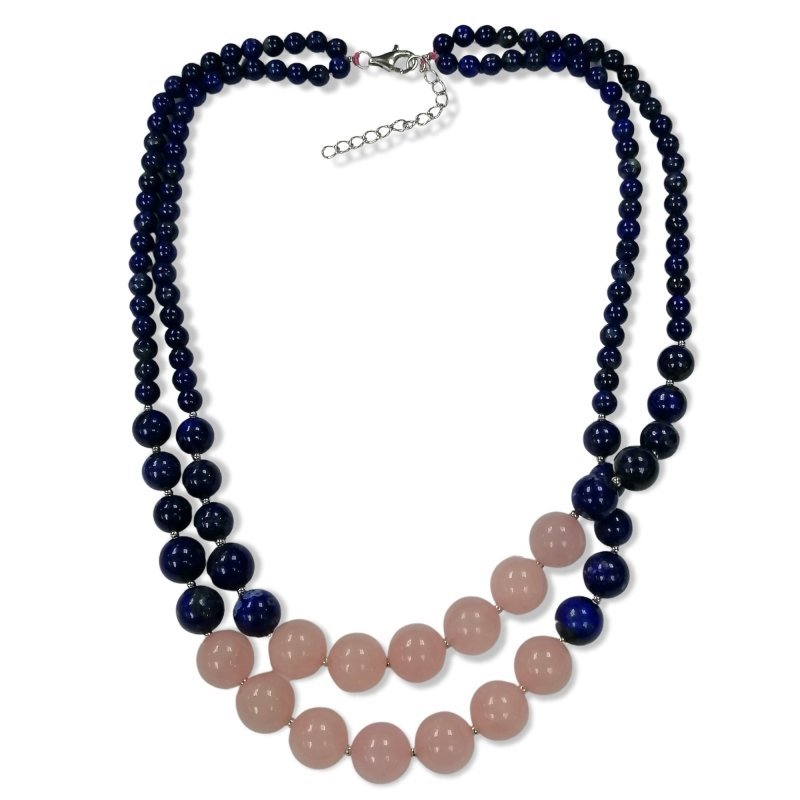

Lapis Lazuli & Aquamarine Necklace 20 Inch
Enquire about this piece ↗

Healing Gemstone Round Beads Beaded Leather Strand & Chain Bracelets

Lapis Lazuli FAQs
Is lapis lazuli valuable?
Fine lapis lazuli with even, deep blue colour and little calcite is valued, but it is not a rare or costly gem in most sizes. Colour, evenness and whether it is dyed matter most.
How can I tell if lapis lazuli is real?
Real lapis usually shows small gold pyrite flecks and some variation in blue. Very even colour with no pyrite can point to glass, dyed howlite or dyed jasper. A gemmologist can confirm it.
Is lapis lazuli dyed?
Often. Paler material is commonly dyed and sealed to deepen the colour. A treated stone is fine to buy if the treatment is disclosed and priced accordingly.
Is lapis lazuli good for everyday rings?
It can be worn daily with care, but at 5–6 on the Mohs scale it scratches more easily than quartz or sapphire. A bezel or protective setting helps.
Where does the best lapis lazuli come from?
The Badakhshan region of Afghanistan is the classic source and still yields the finest deep blue material. Chile, Pakistan and Russia also produce it.
Checked against
Every fact on this page was checked against these references. Gem science moves on, so if you spot something out of date, tell us.
- Lapis LazuliGIA
- Lapis Lazuli History and LoreGIA
- Lapis Lazuli Value, Price, and Jewelry InformationInternational Gem Society
- Lapis LazuliInternational Colored Gemstone Association
- Titian, Bacchus and AriadneThe National Gallery, London