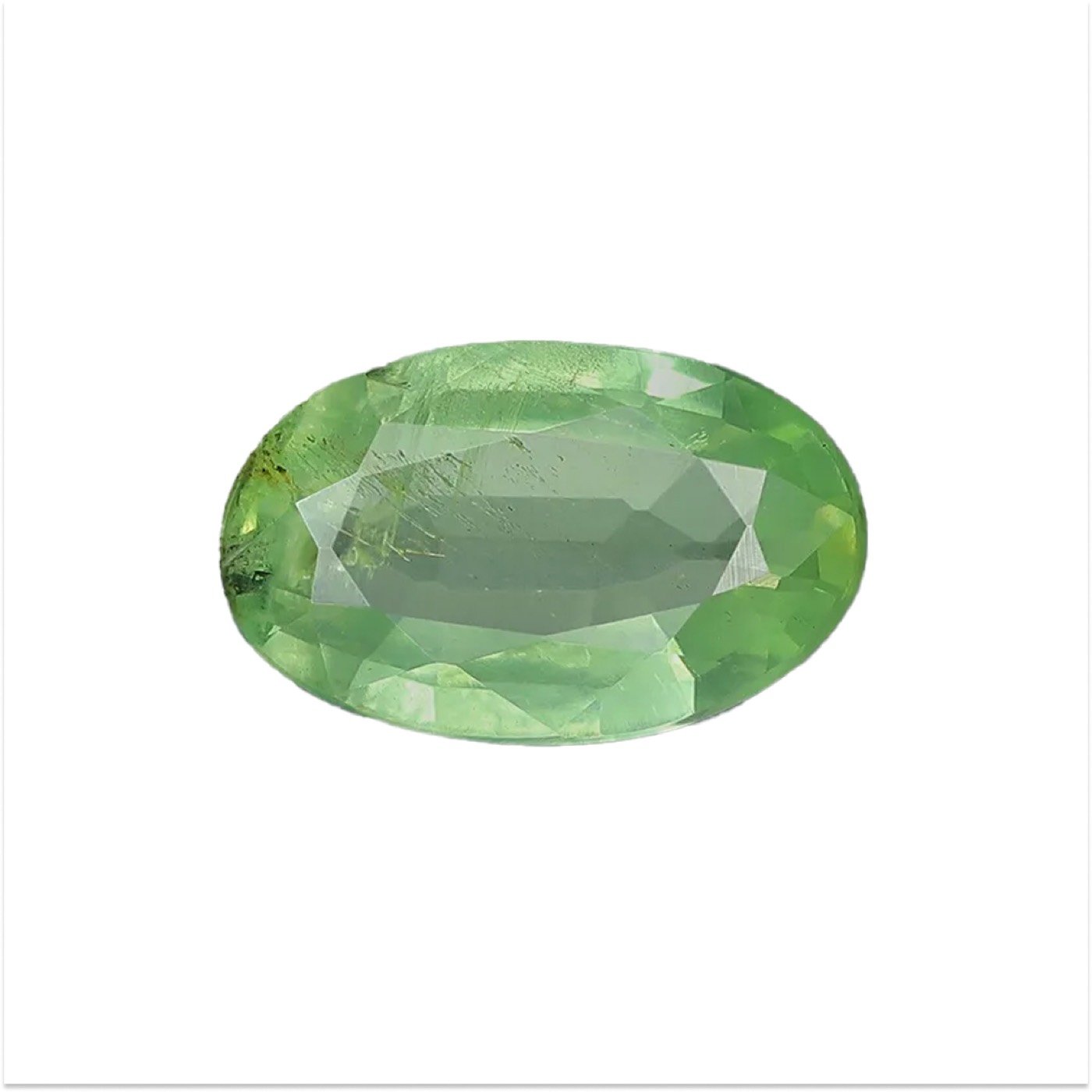
The gem that changes hardness
Most gems have one hardness. Kyanite has a range. Along the long axis of the crystal it measures about 4 to 4.5 on the Mohs scale, close to fluorite. Across that axis it rises to between 6 and 7. The difference comes from the way its atoms are packed: tightly in one direction, more loosely in the other.
For a lapidary, that makes kyanite a puzzle. A facet polished in one direction behaves differently from its neighbour. Add perfect cleavage, which lets the crystal split cleanly along flat planes, and it is easy to see why fine faceted kyanite is less common than its supply of rough would suggest.
Crystals usually grow as long, flat blades, often streaked with deeper and paler blue. Cutters who know the stone read those blades carefully before they start, orienting the table so the softest direction is protected and the best colour faces up. Many simply choose cabochons and beads, which hide the problem and show off the colour.
Kyanite blue, and why it fooled people
The name comes from the Greek kyanos, meaning blue. The best kyanite is a deep, slightly violet blue that can look remarkably like sapphire. GIA’s journal Gems & Gemology notes that blue kyanite has long been used as a sapphire imitation, although the two are easy to separate with gem-testing instruments.
Much of today’s finest blue comes from Nepal. Small-scale miners have worked deposits west-northwest of Kathmandu since the late 1990s, and researchers trace the colour to traces of iron and titanium. Only a small share of the rough is clean enough to facet. Kyanite also comes in green, orange from Tanzania, and colourless or grey.
Look closely and you may see a second trick. Kyanite is pleochroic: it can show different shades of blue, or blue and near colourless, when viewed from different directions. A skilled cutter turns that to advantage, setting the richest tone face-up.
A clue to the deep Earth
Geologists prize kyanite for another reason. It shares its formula, Al₂SiO₅, with two other minerals, andalusite and sillimanite. Which of the three forms depends on pressure and temperature, so kyanite in a rock tells a geologist that the rock was once squeezed deep in the crust.
That same toughness under heat makes ordinary kyanite useful in industry, where most of it ends up in heat-resistant ceramics and furnace linings. Only a sliver of world production is gem quality, which is part of its charm.
The facts
- Mineral family
- Aluminium silicate (polymorph of andalusite and sillimanite)
- Chemical formula
- Al₂SiO₅
- Mohs hardness
- 4–4.5 along the length; 6–7 across it
- Refractive index
- 1.710–1.735
- Specific gravity
- 3.53–3.70
- Crystal system
- Triclinic
- Colours
- Blue, violet-blue, green, orange, colourless, grey
- Main sources
- Nepal, Brazil, Kenya, Tanzania, Madagascar, Mozambique, India, USA
- Birthstone
- —
- Common treatments
- Usually untreated
What makes a good kyanite
Look first at colour. The most sought-after kyanite is a saturated, even blue, neither inky nor washed out. Many stones show colour zoning, with blue bands next to paler areas, and that lowers value in faceted gems while adding character to cabochons.
Clarity matters more than in most coloured stones because cleavage cracks can grow. Clean faceted kyanite over a few carats is uncommon. For calibrated stones, browse our cut and polished gemstones.
- Choose even, saturated blue and check for strong colour zoning
- Look for cleavage cracks near the girdle and corners
- Turn the stone: kyanite shows different shades from different angles
- Ask for a lab test if a “sapphire” seems too cheap
- Bright, flawless “kyanite” beads at very low prices may be glass
Keeping it beautiful
Kyanite’s soft direction and perfect cleavage make it best suited to earrings, pendants and brooches. In a ring, choose a protective setting and take it off for sport, gardening or heavy work. A hard knock can split it. Kyanite bead necklaces and bracelets sit away from most knocks, but they still deserve a soft pouch of their own, away from harder stones.
- Clean with warm, soapy water and a soft brush
- Avoid ultrasonic and steam cleaners
- Avoid sudden temperature changes
- Store separately so harder gems cannot scratch it
Kyanite, from D’sire
For three decades our Hong Kong bench has handled tricky stones such as kyanite. We supply cut and calibrated stones and strands for the trade, and we can source and cut it to your sizes. It also makes a striking choice for earrings and pendants.

Sterling Silver Orange Kyanite Ring

Sterling Silver Orange Kyanite Ring

Sterling Silver Orange Kyanite Ring

Sterling Silver Orange Kyanite Ring


Kyanite FAQs
Is kyanite a valuable gemstone?
Most kyanite is affordable. Clean, faceted stones in a rich, even blue, especially from Nepal, command more because so little rough is suitable for cutting.
Why does kyanite have two hardnesses?
Its atoms are bonded more strongly in one direction than another. It measures about 4 to 4.5 along the crystal’s length and 6 to 7 across it.
Is kyanite good for rings?
It can be worn in a ring with a protective setting and care. Earrings and pendants are safer because kyanite has perfect cleavage and can split if knocked.
How can I tell kyanite from sapphire?
They can look alike, but kyanite has a lower specific gravity, is softer in one direction and gives different refractive index readings. A gemmologist can separate them quickly.
What colours does kyanite come in?
Blue is the classic colour, but kyanite also occurs in green, orange, colourless and grey. Orange kyanite comes from Tanzania.
Checked against
Every fact on this page was checked against these references. Gem science moves on, so if you spot something out of date, tell us.
- Kyanite Value, Price, and Jewelry InformationInternational Gem Society
- KyaniteGemdat.org
- Study helps identify Nepalese kyaniteGIA Gems & Gemology
- Green kyaniteGIA Gems & Gemology